Commercial Lines Underwriting Still Runs on Admin Work
My hot take: the biggest bottleneck in commercial lines underwriting is not appetite, capacity, or even broker responsiveness. It is admin work dressed up as underwriting.
I have seen this movie too many times. A strong underwriter opens a submission, spots the real risk questions in ten minutes, then spends the next hour hunting for the right loss run, re-keying schedule data, checking whether the named insured matches the attachment, and writing a “please send updated values” email that feels oddly similar to the last 47 emails they wrote.
That is like hiring a chef and asking them to spend lunch service alphabetizing the spice rack. Useful? Maybe. Best use of talent? Not unless the restaurant is run by a committee of spreadsheet enthusiasts.
The uncomfortable truth is that many commercial underwriting teams still run on inboxes, PDFs, spreadsheets, portals, and human memory. The underwriter becomes the glue between systems. We call it judgment, but a shocking amount of the day is copy, paste, verify, chase, and repeat.
McKinsey has estimated that as much as 60% of underwriter time can be spent on administrative tasks rather than core risk assessment. If you have ever watched a commercial auto, property, casualty, or fleet submission move through a carrier or MGA, that number does not feel dramatic. It feels Tuesday.
Why commercial lines underwriting attracts admin like a magnet
Personal lines has its own operational headaches, of course. But commercial lines has a special talent for turning every account into a small documentary series.
A commercial submission might include ACORD forms, loss runs, statement of values, driver schedules, vehicle schedules, payroll data, revenue estimates, prior carrier details, risk engineering reports, emails from the broker, emails correcting the first emails, and a PDF named “FINAL_revised_v3_ACTUALFINAL.pdf.” I wish I were joking. I am not.
The reason admin survives in commercial lines is not because underwriters like busywork. It survives because commercial risk is messy. No two accounts look exactly alike. A restaurant, a plumbing contractor, and a regional delivery fleet may all sit in the same pipeline, but they carry different exposures, missing-data patterns, and underwriting questions.
So we built workflows around human effort. If the document is unclear, a person reads it. If the field is missing, a person asks for it. If the data does not match, a person compares it. If the quote system needs clean data, a person types it. Over time, the process becomes normal. Nobody questions why a highly trained underwriter is acting as a part-time document clerk.

Admin work is not harmless
I sometimes hear, “Yes, there is admin, but that is just part of the job.” I disagree. Admin work changes underwriting outcomes.
When a submission sits in an inbox waiting for someone to determine whether it is complete, the best accounts may go elsewhere. Good brokers do not wait forever. They may like your market, but they love a timely quote more. In commercial lines, speed is not a vanity metric. It is a distribution advantage.
Admin also introduces inconsistency. One underwriter may catch a missing vehicle radius detail. Another may miss it because they are overloaded. One team may apply an eligibility rule tightly. Another may rely on tribal knowledge. That does not mean people are careless. It means humans are being asked to run repeatable checks at scale while also making nuanced risk decisions. Those are different jobs.
Then there is premium leakage. If exposure data is incomplete, inconsistent, or manually transferred, pricing accuracy suffers. A misplaced class code, outdated payroll number, missing garaging location, or incorrect driver count can quietly turn into real money. You may not see it at bind. You see it later, in loss ratio movement, endorsement churn, audit disputes, or renewal surprises.
And perhaps the most underestimated cost is morale. Underwriters want to underwrite. They want to weigh trade-offs, understand businesses, negotiate terms, and build strong broker relationships. Very few people enter commercial underwriting because they dream of comparing two spreadsheets cell by cell under fluorescent lighting.
The real goal is fewer dirty files
Here is the hot take I would put on a mug: underwriters do not need to work faster. They need to see cleaner files.
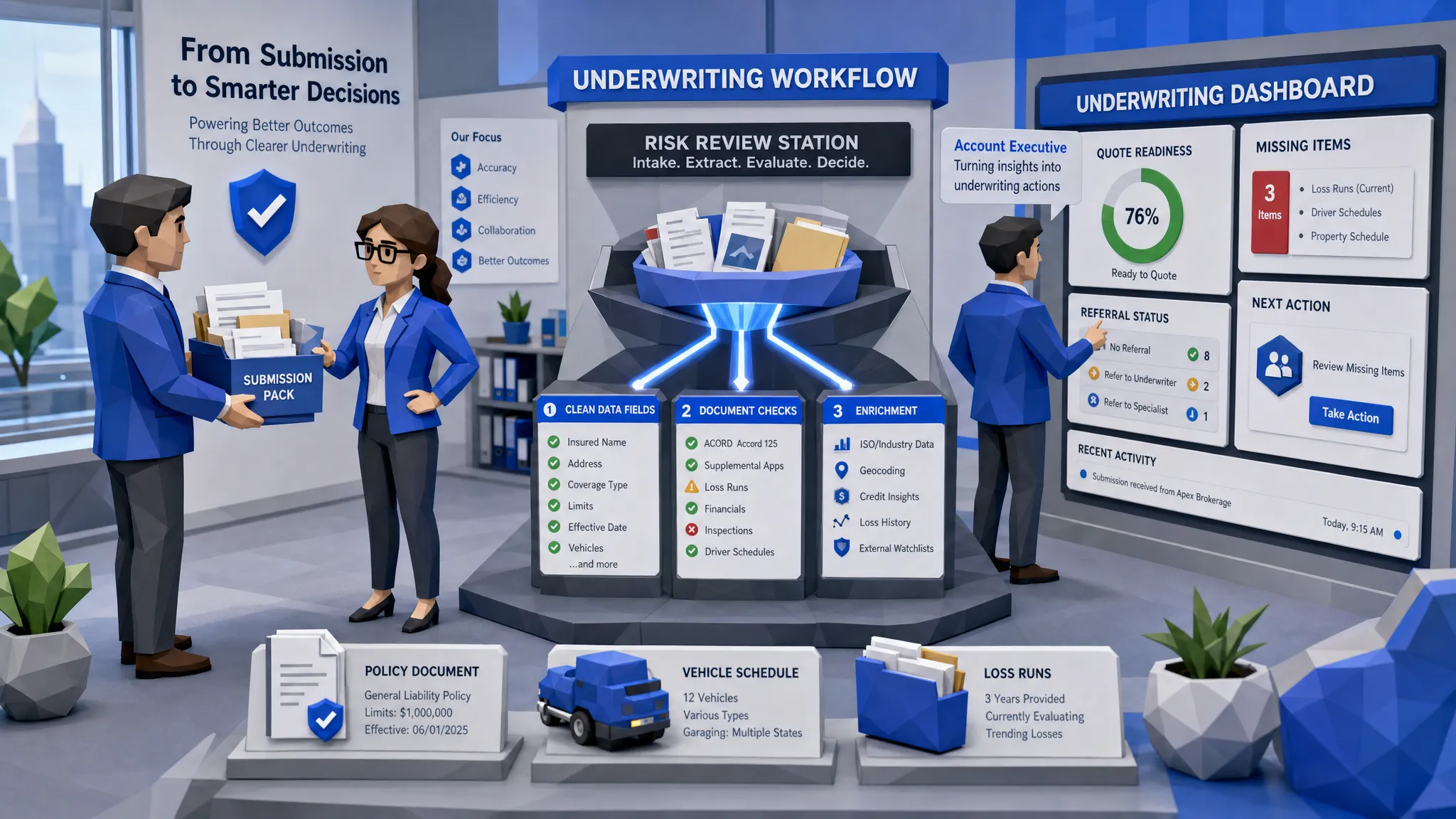
There is a difference. Asking an underwriter to move faster through a messy submission is just politely asking them to absorb more operational pain. Cleaner files change the game. By the time a submission reaches an underwriter, the basics should already be handled. Documents should be identified. Key fields should be extracted. Missing items should be flagged. External data should be pulled where appropriate. Appetite rules should be checked. Referral reasons should be visible.
The underwriter should not have to wonder, “Do we have the right loss runs?” They should be asking, “Given this loss pattern and exposure mix, do we want this account at this price?” That is the job.
I once watched an underwriter handle a small commercial fleet account where the actual risk decision took maybe 20 minutes. The rest of the time went into figuring out whether the driver list matched the vehicle schedule, whether three VINs were missing digits, and whether the prior loss information covered three years or four. If you explained that workflow to someone outside insurance, they would assume we were describing a process from 1998. Unfortunately, a lot of 2026 underwriting still has a 1998 filing cabinet hiding inside it.
What a healthier underwriting workflow looks like
A better commercial lines underwriting workflow starts before the underwriter opens the file.
The submission arrives through email, portal, API, or a broker attachment. The system reads the incoming materials, identifies the documents, extracts the key data, and organizes the submission into a usable structure. If the loss runs are missing, the workflow flags that immediately. If the vehicle schedule has invalid VINs, it catches them before the underwriter spends time on the account. If the business falls outside appetite, the team knows quickly and can respond professionally rather than letting the file age in silence.
This is where automation earns its keep. I am not talking about replacing underwriting judgment. I am talking about removing the chores that block judgment from happening.
The workflow should also enrich the file. In commercial property, that might mean location-level hazard information. In commercial auto, it might mean vehicle, driver, or territory checks. In broader P&C lines, it may include third-party data, public records, prior losses, or benchmark comparisons. The point is not to drown the underwriter in more data. The point is to give them the right data in the right place, before the broker calls for an update.
Sales teams already understand this principle. They qualify leads before asking a senior seller to spend time on a call, and firms such as a B2B customer acquisition agency build entire operating systems around disciplined pipeline handoffs. Underwriting deserves the same respect. Not every submission should consume senior underwriting attention before it has been cleaned, checked, and routed.
The inbox should not be your operating model
I have nothing against email. Email is fine for communication. It is terrible as an operating model.
Many underwriting teams still treat the shared inbox as the first system of record. The inbox decides what gets seen, what gets chased, and what gets forgotten. That is a little like letting the mailroom run portfolio strategy. Charming in a sitcom, risky in an insurance operation.
The problem with inbox-led underwriting is that it hides the work. You can count submissions received, quotes issued, and binds. But what about the invisible middle? How many files were incomplete at intake? Which brokers send the cleanest submissions? Which fields are most often missing? Which eligibility rules cause the most referrals? Which underwriters are spending half their day chasing documents instead of assessing risk?
Without structured data, leaders manage by anecdote. The loudest pain point wins the next operations meeting. The best underwriting organizations are moving past that. They are turning the submission process itself into data.
That is where a unified data layer matters. When every workflow captures what happened, what was missing, what was checked, and why a decision was made, you get more than speed. You get visibility. You can see bottlenecks, broker quality, portfolio trends, and operational leakage.
The metrics I would actually watch
If I were running a commercial underwriting operation, I would care about quote volume, but I would not stop there. Volume can hide chaos. A team can issue more quotes while burning out underwriters and accepting messy risks.
I would watch a few practical measures that show whether admin is shrinking:
- Time from submission receipt to first meaningful response
- Percentage of submissions complete at intake
- Number of broker follow-ups required before underwriting review
- Re-keying touchpoints per submission
- Referral reasons by line, broker, and underwriter
- Quote-to-bind ratio by submission quality
- Loss ratio trends tied to original underwriting data quality
That last one matters. If bad intake data correlates with poor downstream performance, admin is no longer an operations nuisance. It is a profitability issue.
Where Inaza fits into this shift
At Inaza, we see this problem every day across insurers, MGAs, brokers, and claims teams. The common thread is not lack of talent. It is that talented people are trapped inside workflows that ask them to do too much manual coordination.
Inaza’s insurance automation platform is built to help teams capture data, automate workflows, and integrate with existing systems without forcing everyone to relearn how to do their jobs. For underwriting teams, that means submissions can be converted from scattered files and messages into structured workflows. The platform supports all file types, uses customizable workflow templates, and can connect into existing tools so teams do not have to rip out core systems to make progress.
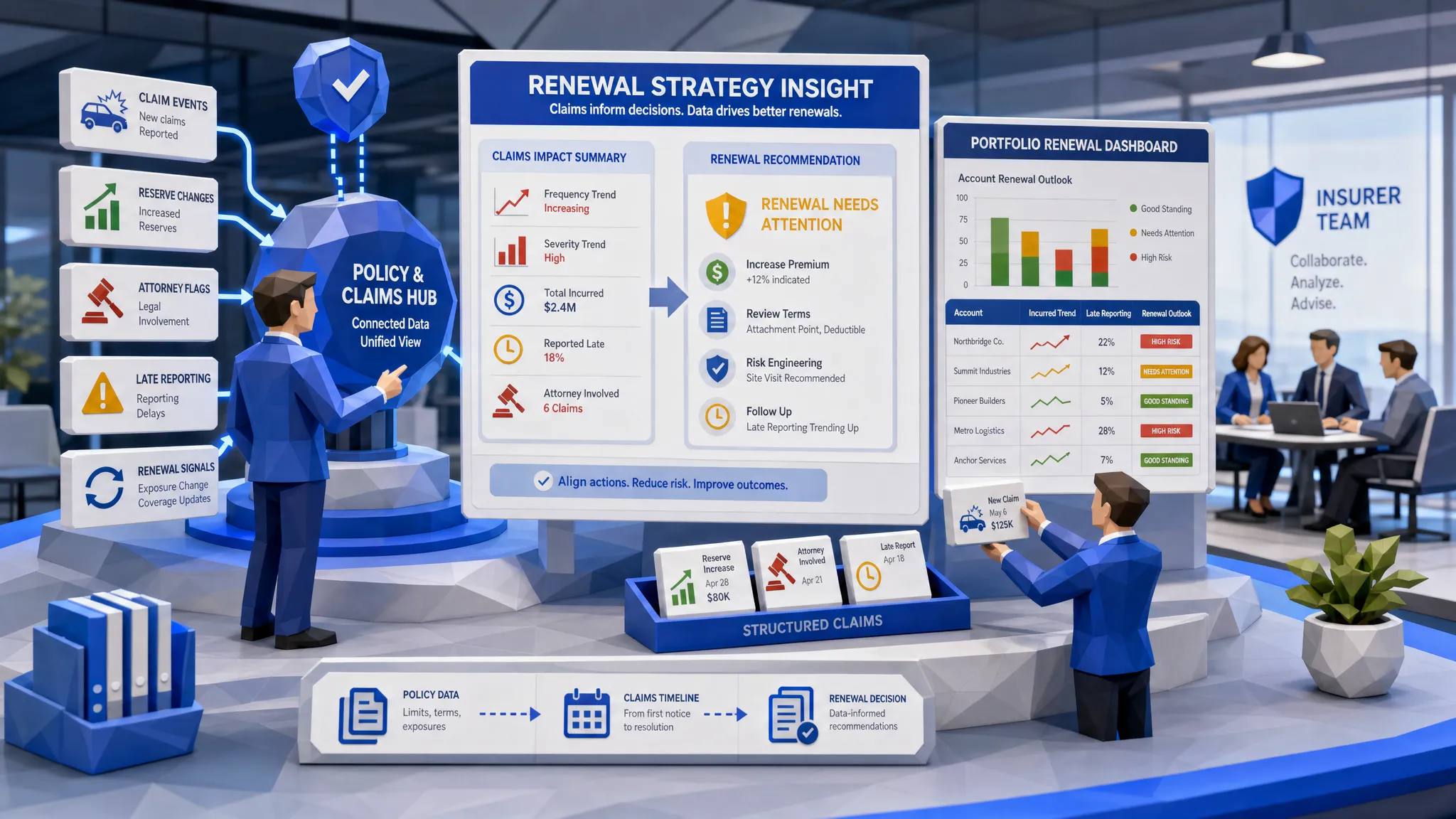
The part I think underwriting leaders should pay more attention to is the data warehouse underneath the automation. Automating a task is useful. Capturing the data from that task is where the long-term advantage starts. Once submission intake, referrals, missing fields, enrichment checks, and decision points are structured, you can build real dashboards. You can compare performance across brokers, lines, regions, and portfolios. You can also use market benchmarks, including sources such as Aon, Munich Re, Howden, and others where relevant, to support portfolio narratives for renewals and reinsurance conversations.
Inaza also has pre-built API templates for data sources such as Verisk, LexisNexis, HazardHub, and more. That matters because underwriting automation should not stop at reading documents. It should help complete the picture around the risk.
And yes, deployment speed matters. Nobody wants another six-month proof of concept that ends with a nice slide deck and no production workflow. Inaza is designed to help insurers deploy practical workflows quickly, including production-ready workflows from a single working session when the process is clearly defined.
The underwriter still owns the decision
Let me be clear: commercial lines underwriting still needs human judgment. Probably more than ever.
Automation should not flatten every account into a yes or no. The best commercial underwriters understand nuance. They know when a tough account is worth writing because the broker has strong controls, the insured is improving, or the pricing and terms make sense. They can interpret a loss story, negotiate coverage, and see portfolio context in a way a simple rules engine cannot.
But judgment should be reserved for judgment. If a file needs a human because the exposure is complex, great. If it needs a human because the PDF was sideways and the spreadsheet had merged cells, that is a process failure.
The winners in commercial lines will not be the companies that automate everything blindly. They will be the companies that decide, with discipline, which tasks belong to systems and which decisions belong to underwriters.
Frequently Asked Questions
Why is commercial lines underwriting so admin-heavy? Commercial submissions often include multiple documents, inconsistent formats, broker emails, schedules, loss runs, and third-party checks. Because many systems do not automatically structure this information, underwriters end up doing manual intake, validation, and follow-up work.
Does underwriting automation replace underwriters? No. Good automation removes repetitive tasks such as document sorting, data extraction, eligibility checks, and missing-information follow-up. Underwriters still make the risk decisions, manage broker relationships, and handle complex exceptions.
What is the biggest benefit of reducing admin in commercial underwriting? Speed is the obvious benefit, but consistency may be even more valuable. Cleaner intake and structured workflows reduce missed data, improve auditability, and help teams apply underwriting rules more consistently across submissions.
How should carriers and MGAs start reducing underwriting admin? Start with the highest-friction intake points, usually shared inboxes, loss runs, schedules, and missing data follow-ups. Automate those first, measure the reduction in touches and response time, then expand into enrichment, referrals, and reporting.
Let underwriters underwrite
Commercial lines underwriting will always involve complexity. That is the point. But complexity should come from the risk, not from the process.
If your underwriters spend more time cleaning files than evaluating accounts, the operation is quietly taxing your best people. The good news is that this is fixable. With the right automation, integrations, and data foundation, insurers can turn submission chaos into cleaner decisions, faster broker responses, and better portfolio visibility.
If you want to see how Inaza helps underwriting teams reduce admin work without disrupting existing systems, explore Inaza’s insurance automation platform and start a conversation with our team.